Alan Louis | Portrait of an Artist


French artist and designer Alan Louis creates objects that resist easy definition. Somewhere between art, design and craft, his pieces feel at once ancient and contemporary, functional and sculptural. They seem to carry traces of architecture, landscape, ornament and memory as if each object had its own past.
Alan Louis did not come to design through a traditional academic path. Before dedicating himself to design, he worked in the merchant navy, in a world where materials had to be understood, assembled and repaired. This technical background gave him a direct, physical relationship with matter — one that still shapes the way he works today.
« I think my past in the merchant navy shaped my creativity and my approach to materiality in a way that was more technical than artistic. I know how materials work and how to assemble them, I learned to weld, I learned how to find a solution when there’s a problem. »
Alan Louis likes to understand how a material behaves and how far it can be pushed. Each piece begins as a dialogue between an idea and a material. There is the initial design, then the research, the tests, the accidents, the adjustments… This long, often uncertain process is what continues to drive his work every day and to motivate him.Without formal training in design, Alan Louis has kept a certain freedom in the way he approaches objects. Unbound by the rules of a discipline, he moves more instinctively :« I feel completely free in my ideas. I follow my own desires more than rules. The shapes and materials I use are not always conventional for the objects I create — and I like playing with that. »
Alan Louis did not come to design through a traditional academic path. Before dedicating himself to design, he worked in the merchant navy, in a world where materials had to be understood, assembled and repaired. This technical background gave him a direct, physical relationship with matter - one that still shapes the way he works today.
« I think my past in the merchant navy shaped my creativity and my approach to materiality in a way that was more technical than artistic. I know how materials work and how to assemble them, I learned to weld, I learned how to find a solution when there’s a problem. »
Alan Louis likes to understand how a material behaves and how far it can be pushed. Each piece begins as a dialogue between an idea and a material. There is the initial design, then the research, the tests, the accidents, the adjustments… This long, often uncertain process is what continues to drive his work every day and to motivate him. Without formal training in design, Alan Louis has kept a certain freedom in the way he approaches objects. Unbound by the rules of a discipline, he moves more instinctively : « I feel completely free in my ideas. I follow my own desires more than rules. The shapes and materials I use are not always conventional for the objects I create -and I like playing with that. »
Each piece begins with an image in his mind. The challenge is then to make it live through ceramic, or through the other materials he works with. Research, tests and adjustments are all part of the process.
« I like the challenge. When I have the idea of an object in my head, the challenge is to make it alive with ceramic or with the other materials I work with. I have to think about how to make the result match as closely as possible the original idea. From this comes a long process of research and experimentation, and that is what stimulates me every day. »
Alan Louis is adamant that a particular material should never be reduced to one fixed appearance. In his hands, what at first glance appears to be metal, wood, copper, cork, or steel is actually ceramic. For Alan Louis, this is not only a visual effect. It is part of his belief that ceramic can take on almost any appearance, and that a material should never be limited to one fixed identity.
« I use ceramic with metal-effect glazing instead of real metal, and the same with wood. It is not always the easiest way, but I think that is what makes my work a bit different. It is how I found my own space in the world of design.”“It is not always the easiest path, but I think this is also what makes my work different. It is how I found my place in the world of design. »
Alan Louis came to ceramics at a moment of transition. After the merchant navy, he found himself questioning what he wanted to do with the rest of his life. He took months off, began drawing portraits, animals and objects. Then Covid arrived, and the world suddenly stopped.
« Everything seemed to be going towards failure from the outside, but I decided to take that moment as an opportunity to introspect and create. I had just moved to Portugal, and when I started looking into its history, I discovered how important ceramics was in the culture. »
Portugal gave him the context, the time and the space he needed. As his artistic practice began to take up more space, both mentally and physically, Alan Louis decided to leave Lisbon and move to the Ribatejo. He felt the need for more peace and quiet, for a life closer to nature.
« I fell in love with the environment immediately. It is warm and green, with a view of the Serra de Montejunto from wherever you stand. It is so inspiring that I spend most of my time there in the middle of the trees, with the sun and music. »

Portugal gave him the context, the time and the space he needed.
As his artistic practice began to take up more space, both mentally and physically, Alan Louis decided to leave Lisbon and move to the Ribatejo. He felt the need for more peace and quiet, for a life closer to nature.
« I fell in love with the environment immediately. It is warm and green, with a view of the Serra de Montejunto from wherever you stand. It is so inspiring that I spend most of my time there in the middle of the trees, with the sun and music. »
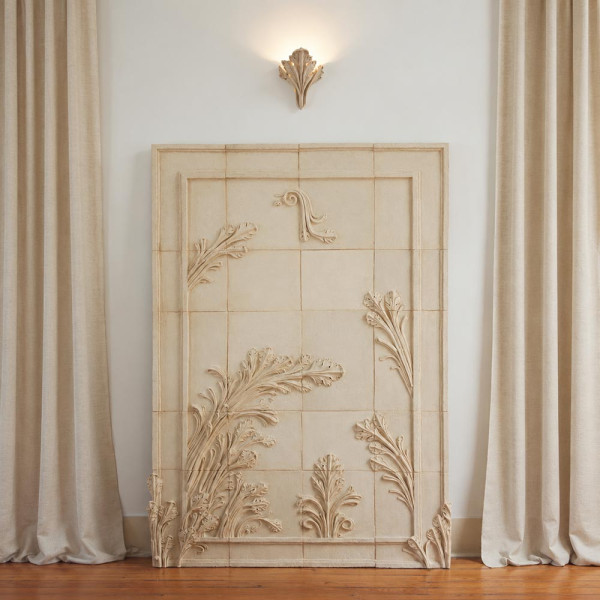
This landscape has deeply influenced his work, especially Narciso, a collection based on sculptural vegetation. But Narciso is not only inspired by nature. It also carries the traces of a historic Europe that has always fascinated Alan Louis.
« For Narciso, I deeply wanted to bring in my souvenirs of museums, old palaces, all the heritage that we have. I have a passion for it: old gilded frames that I used to restore with plaster and gold leaf, paintings, old churches and castles, the smell of incense ...»
Working with chamotte stoneware has also shaped Alan Louis’ approach. It is a difficult material, often unpredictable.
This landscape has deeply influenced his work, especially Narciso, a collection based on sculptural vegetation. But Narciso is not only inspired by nature. It also carries the traces of a historic Europe that has always fascinated Alan Louis.
« For Narciso, I deeply wanted to bring in my souvenirs of museums, old palaces, all the heritage that we have. I have a passion for it: old gilded frames that I used to restore with plaster and gold leaf, paintings, old churches and castles, the smell of incense ... »
Working with chamotte stoneware has also shaped Alan Louis’ approach. It is a difficult material, often unpredictable.
« Chamotte stoneware is very difficult to dominate, but I learned how to work with it without forcing it. Cracks, explosions in the kiln and deformations happened a lot at the beginning. Then I learned what I can do and what I cannot. Step by step. Now I would say that the stoneware and I know our limits and create together. » This relationship with the material says a lot about his work. Creation, for Alan Louis, is all about listening, adjusting, and finding a balance between control and accident. The same idea appears in his use of glaze. He waited before introducing it, but soon felt the need to add an extra layer to his works.
« Glazing is very difficult because you cannot fully control the clay, and then you add a glaze that you cannot fully control either. So you have two difficulties to compose with. I waited before introducing it because I wanted to know how to work properly with clay itself. »
« Chamotte stoneware is very difficult to dominate, but I learned how to work with it without forcing it. Cracks, explosions in the kiln and deformations happened a lot at the beginning. Then I learned what I can do and what I cannot. Step by step. Now I would say that the stoneware and I know our limits and create together. »
This relationship with the material says a lot about his work. Creation, for Alan Louis, is all about listening, adjusting, and finding a balance between control and accident. The same idea appears in his use of glaze. He waited before introducing it, but soon felt the need to add an extra layer to his works.
« Glazing is very difficult because you cannot fully control the clay, and then you add a glaze that you cannot fully control either. So you have two difficulties to compose with. I waited before introducing it because I wanted to know how to work properly with clay itself. »
With glossy glazes that imitate precious wood, metal, copper, cork or steel, Alan Louis creates a moment of uncertainty. The viewer wonders, even if only for a second, what the object is made of. « I wanted the viewer to question for a second: is that ceramic, wood, cork, steel or copper? I wanted to show that with ceramic, you can take on any appearance you want. »
This play between opposites runs through all of his work. His pieces balance sculptural strength and delicacy, clean simple lines and ornamentation. For him, these contrasts are not contradictions. They are what make an object feel alive. « My pieces tend to oscillate between sculptural strength and delicacy, probably because I feel quite strong and very sensitive at the same time. For me an object always reflects what lives inside the person who makes it. »
The Era and Narciso collections, presented during Lisbon Design Week, illustrate this perfectly. Era is minimal, structured, almost architectural. Narciso is organic, ornamental and extravagant.
« Pure straight lines and random curves, contemporary and ancient, rough and sophisticated - it is all a matter of making them match. It is part of my desire for freedom, for not being categorised. Design? Art? Decoration? I like to stay undefined, treading a thin line between art and function. »
At Lisbon Design Week, Alan Louis conceived the spaces as jewellery boxes for his collections : immersive settings that would highlight his work without overpowering it. In historic interiors, this balance is delicate : the architecture can easily take over, making the objects disappear.
In the end, what Alan Louis wants to share goes beyond the beauty of a form. His objects carry effort, memory, nostalgia, determination and what he calls a kind of “happy rage.” They are meant to feel strong, as if they already had a past. « I hope people can feel the happy rage I put into it - all the emotions, the nostalgia, the souvenirs and determination that I carry - so the objects can be loud enough to seem as if they have a past and a history behind them. In the end, I hope my work can create reactions, good or bad, because there is nothing worse than indifference. »
Perhaps this is where his work is most powerful: in its refusal to be neutral. His pieces hold something intensely personal. Through ceramics, Alan Louis gives shape to what moves him - whilst leaving space for each viewer to recognise, in turn, an emotion, a memory or a story of their own.
Shop The Look